
You Just Inherited Money: What to Do First
You Just Inherited Money: What to Do First
Coming into an inheritance is a strange mix of feelings. There is often grief, because the money usually comes after losing someone you care about. There can also be relief, pressure, or even guilt. On top of all that, you may feel a quiet panic about doing the right thing with the money.
Here is the good news. You have more time than you think. The smartest first move is almost never a big move. Let us walk through what to do first, one calm step at a time.
First, Pause and Park the Money
There is no rush. Money that has been waiting in an estate is not going anywhere, and a few weeks or months of thinking time will not hurt you. In fact, that pause can save you from choices you might regret.
When a large sum lands in your account, it can feel like you should do something with it right away. Resist that pull. Big decisions made in the early days of grief or excitement are often the ones people wish they could undo.
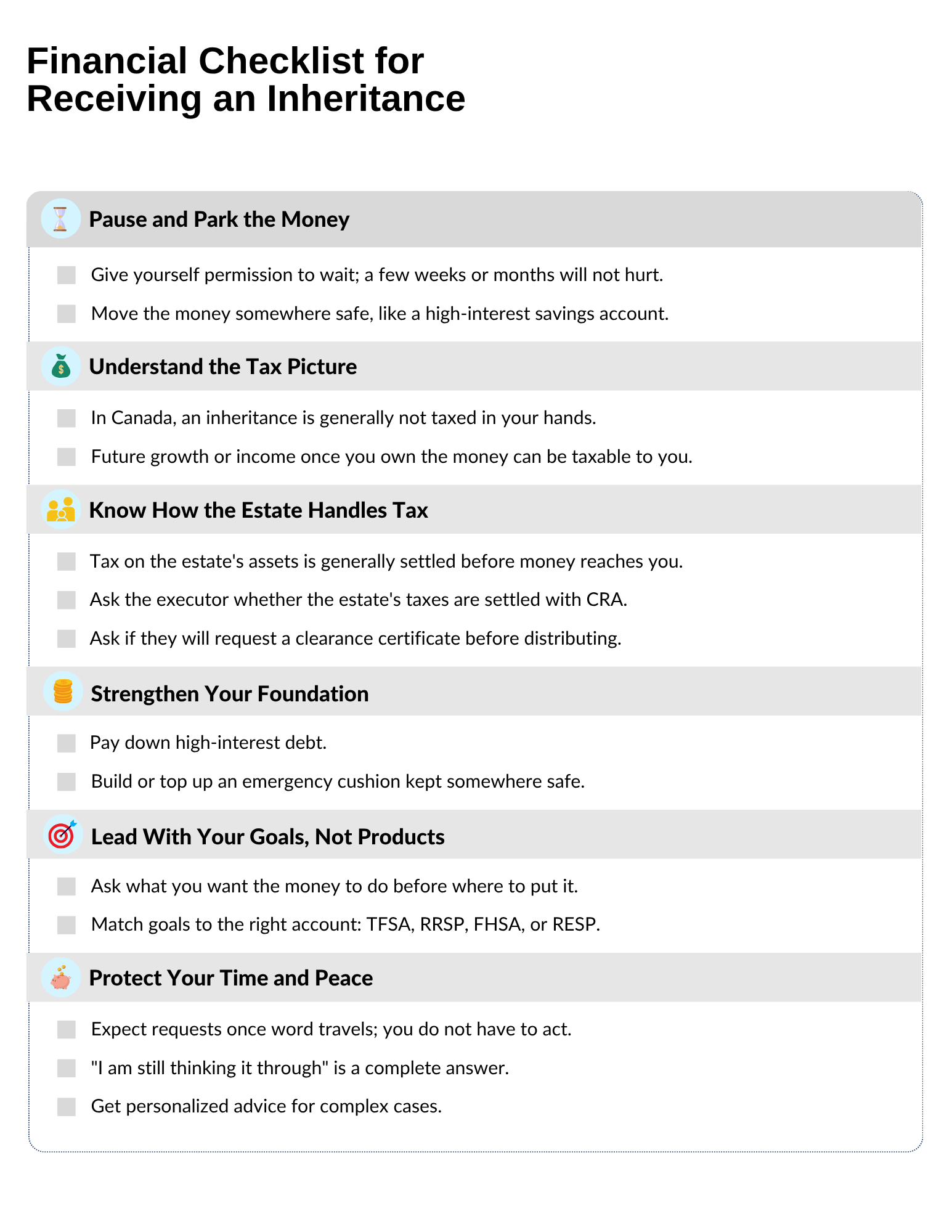
For now, put the money somewhere safe and boring. A high-interest savings account is a good home. Your money stays easy to reach, it is protected, and it earns a bit while you think. There is no need to invest it, lend it, or spend it until you have had time to plan with a clear head.
Understand the Tax Picture
This part surprises a lot of people, in a good way. In Canada, an inheritance is generally not taxed in the hands of the person who receives it. You usually do not report the money you inherit as income, and you do not pay tax just for receiving it.
Why is that? Because the tax is generally settled by the estate before the money reaches you. When someone passes away, their final tax return is prepared, and any tax owing on their assets is handled at that stage. The money is usually distributed to family and other heirs after that step. So by the time it gets to you, the tax piece has generally already been dealt with.
This does not mean money you inherit is tax-free forever. Once you own it, any future growth, interest, or income it earns can be taxable to you, just like your other money. But the act of inheriting it, on its own, generally does not create a tax bill for you.
How Assets Are Treated in the Estate
For most people receiving an inheritance, the reassuring part is that this tax work happens at the estate level, not yours. You usually do not pay tax just for receiving an inheritance. If you would like to understand what happens behind the scenes, here is what happens to different assets before they reach you. The rules depend on the type of asset.
For non-registered assets, such as an investment account or a property that is not a primary home, assets are generally deemed disposed at fair market value on death, and accrued gains are reported on the final return unless a spousal rollover applies. The rollover works like this: these assets can roll to a spouse or common-law partner, or a qualifying spousal trust, on a tax-deferred basis. Otherwise, the accrued gain is reported on the final return.
For an RRSP or RRIF, the full value is generally treated as received and added to income on the final return, except where a spouse or common-law partner is a successor annuitant or receives an eligible rollover, or where a financially dependent child or grandchild qualifies for a rollover.
For a TFSA, growth inside a TFSA is tax-free to the date of death. A spouse or common-law partner named as successor holder can continue it tax-free, where that option is available. A named beneficiary follows set steps, and later growth can be taxable.
One simple thing is worth doing as a beneficiary: it is fair to ask the executor whether the estate’s taxes are settled, and whether they have requested a clearance certificate, before the estate is fully wound up. A clearance certificate is CRA’s confirmation that the estate’s taxes are paid, and it is something the executor may want to request before distributing the estate.
Pay Down Debt and Shore Up Savings
Once you have paused and you understand the tax basics, you can start to think about using the money well. Two steps tend to give the best return for the least worry.
The first is paying down high-interest debt. Credit card balances and other costly loans can quietly drain your budget every month. Clearing them is like giving yourself a guaranteed return, because you stop paying that interest for good. Few investments can promise that.
The second is building or topping up an emergency cushion. This is simply cash set aside for surprises, kept somewhere safe and easy to reach, like that high-interest savings account. A solid cushion means the next car repair or job hiccup does not throw your life off track. Together, clearing costly debt and holding a cash buffer give you a calm, steady base before you do anything fancier.
Think About Goals Before Products
It is tempting to jump straight to “where should I put this money?” A better question is “what do I want this money to do for me?” Goals come first. Products come second.
Maybe you want to retire a little sooner, buy a first home, save for a child’s schooling, or just feel more secure. Once your goals are clear, registered accounts can help you reach them, and each one has a job:
-
A TFSA lets your savings grow tax-free, and you can take money out for any purpose.
-
An RRSP is built for retirement and can lower your taxable income in the year you contribute.
-
An FHSA is designed to help you save toward a first home.
-
An RESP helps you save for a child’s education after high school, with government grants that add to what you put in.
Each account has its own contribution room and rules, and these change over time. You can check your available room and the current limits through CRA My Account or at canada.ca. Matching the right account to the right goal is what turns a windfall into lasting progress.
If your situation involves cross-border elements, such as inheriting foreign property, or executors or beneficiaries in different countries, the tax picture can be more complex and may involve foreign reporting or foreign estate taxes. That is one of the times when personalized advice is well worth it.
Watch for Pressure and Take Your Time
A sudden sum of money can change how people treat you, and how you feel. Word travels. You may get requests for loans, gifts, or “can’t-miss” opportunities. You may also feel pressure inside your own family about what the money should be used for.
None of that means you must act. It is your inheritance, and you are allowed to take your time. A simple, kind answer works well: “I am still thinking it through.” That one sentence buys you space and protects you from rushed choices.
Coming into money you did not plan for is a lot to hold, especially when it follows a loss. So go gently. Park it somewhere safe, remember that your inheritance is generally not taxed to you when you receive it, and let your goals lead the way. The single best first step is often the simplest one: give yourself permission to pause. What would feeling truly settled with this money look like for you?
This content is provided for general informational purposes only. It is not intended to provide investment, tax, or legal advice, and should not be relied upon as such.
Sources:


