Why a Critical Illness Insurance Top-Up Could Make a Big Difference

Most of us don’t expect to face a serious illness in our lifetime. But the truth is, health challenges such as cancer, heart disease, or stroke are more common than many people realize. In fact, about half of Canadians will develop cancer at some point in their lives. The question is—would your family or business be financially ready if something unexpected happened?

Critical illness insurance is designed to provide a lump-sum payment if you’re diagnosed with a covered illness. Many employees have some level of coverage through work, and some business owners purchase policies personally. But here’s the challenge: the amount of coverage included in a standard policy often isn’t enough to fully protect your income, household, or business. That’s where a “top-up” comes in.

Adding extra coverage can help close the gap, offering peace of mind and flexibility at a time when you’d want to focus fully on recovery.

Understanding the gap in coverage

Group insurance provided through an employer is a valuable benefit, but it usually comes with limits. For example, coverage amounts may be capped at a set level, such as $25,000 or $50,000. While helpful, this amount might not go far if you’re facing months away from work or costly medical treatments not fully covered by government health care.

For families, this shortfall can mean dipping into savings or going into debt just to keep up with everyday bills. For business owners, it could mean not having enough cash flow to keep operations running smoothly while stepping away to focus on health. A top-up ensures your coverage reflects your actual financial responsibilities, not just a general amount offered in a group plan.

Why families consider a top-up

If you’re raising children or supporting loved ones, an unexpected illness can bring financial stress on top of emotional strain. Mortgage payments, daycare costs, grocery bills, and education savings don’t pause when life takes a turn. A top-up can provide additional funds to help cover household expenses or even allow a spouse to take time off work to provide care.

Think of it as a financial cushion that allows your family to focus on what matters most—supporting your recovery—without the added worry of how to make ends meet.

Why employees might need more than their work plan

Relying only on your workplace benefits can leave you underinsured. Employer coverage usually ends if you change jobs, retire, or if your company makes changes to its benefits package. That means you could lose coverage at a time when it might be harder to qualify for new insurance.

By topping up your coverage personally, you’re not only increasing your protection—you’re also making sure you have something portable that stays with you, no matter where your career takes you. This stability can be especially valuable for professionals in industries where job changes are common.

Why business owners look at top-ups differently

For business owners, the stakes are even higher. A serious illness doesn’t just affect you personally—it can affect your entire company. From paying employees and suppliers to covering rent and utilities, your business may still need to run while you’re focused on treatment and recovery.

A top-up can provide a financial buffer to keep things running smoothly. It may also give you flexibility to hire temporary help, reduce workload, or take the time you need without rushing back before you’re ready. This not only protects your own livelihood but also helps safeguard your employees and clients who depend on you.

The benefits of a top-up

When deciding whether to add more coverage, here are some of the benefits families, employees, and business owners often value:

  • Peace of mind: Knowing you’re covered beyond the basics can relieve stress.
  • Financial flexibility: The lump-sum payment can be used for anything—from medical costs to everyday expenses.
  • Control: Unlike some insurance benefits, you choose how the funds are used.
  • Portability: A personal top-up stays with you, even if your job changes.
  • Business continuity: For entrepreneurs, extra coverage can help keep the business stable while you recover.

At its core, a critical illness insurance top-up is about creating a stronger safety net. It’s about having the right level of protection for your specific needs, rather than relying on a “one-size-fits-all” amount that may fall short.

Life is unpredictable, but preparing for the unexpected can make a big difference. By topping up your coverage, you’re helping ensure that if illness strikes, you and your loved ones can focus on what really matters—healing and moving forward.

If you’re unsure how much coverage is right for you, it may help to review your current benefits, your family’s expenses, and any business obligations you’re responsible for.

This is for informational purposes only and does not constitute financial, legal, or tax advice. Always consult a qualified professional regarding your specific situation. We are not responsible for any actions taken based on this content.


How to Choose and Customize a Group Benefits Plan for Small Businesses

Building a Bright and Sustainable Future Together

As a small business owner, you recognize the significance of looking after your team and fostering a nurturing work environment. One method to demonstrate this is by providing a robust group benefits plan. This not only reflects your dedication to your team’s well-being but also is instrumental in drawing and retaining the best talent. Dive into the realm of group benefits and discover how to select and tailor the ideal plan for your small enterprise.

Understanding the Basics of Group Benefits

Group benefits plans are crafted to offer a variety of health, financial, and wellness advantages to your team members. These packages can encompass health and dental insurance, life and disability insurance, retirement savings alternatives, and more. The main benefit of a group benefits plan is its ability to distribute the risk among your team, making coverage more cost-effective and reachable for all.

Step 1: Assess Your Business Needs

Before diving into a group benefits plan, it’s vital to evaluate the requirements of your business and your team. Ponder over these questions:

  1. What’s the profile of your workforce? Think about age, family composition, and health statuses.
  2. Which benefits are most cherished by your employees? Is it health insurance, dental care, or retirement savings?
  3. How much can you allocate for group benefits? Keep in mind, offering benefits is a commitment to your team’s welfare.

Step 2: Collaborate with a Benefits Specialist

Teaming up with a benefits specialist is akin to having a navigator on your quest to devise the perfect plan. They will assist you in traversing the intricate landscape of insurance choices, rules, and compliance mandates. They’ll engage closely with you to grasp the distinct needs of your business and craft a plan that matches your budget and principles.

Step 3: Customize Your Plan

Adaptability is paramount when shaping a benefits plan that appeals to your team. Here are some avenues for personalization:

  1. Benefit Choices: Opt for a blend of health, dental, vision, life, and disability insurance based on what your team values.
  2. Wellness Initiatives: Mull over introducing wellness programs such as fitness center memberships, mental health resources, and stress alleviation workshops.
  3. Retirement Schemes: Offer retirement savings avenues like a Group RRSP or a staff pension scheme.

Step 4: Educate Your Employees

The efficacy of a group benefits plan hinges on transparent communication and enlightenment. Ensure your team comprehends the worth of the benefits provided and the methods to utilize them optimally. Arrange seminars, online sessions, or informational meetups to aid them in making knowledgeable choices about their coverage.

Step 5: Regularly Review and Adjust

The dynamics of your business and the needs of your team will transform over time. Hence, it’s crucial to revisit your group benefits plan annually and make requisite modifications. This guarantees that your plan stays in sync with your objectives and consistently delivers value to your team.

Building a Sustainable Future Together

As you embark on the path of picking and personalizing a group benefits plan for your small enterprise, bear in mind that your collaboration with your team is central to the process. By placing their welfare at the forefront and presenting a comprehensive benefits package, you’re not merely paving a brighter path for your team but also cultivating a sustainable work setting that promotes allegiance, efficiency, and expansion.

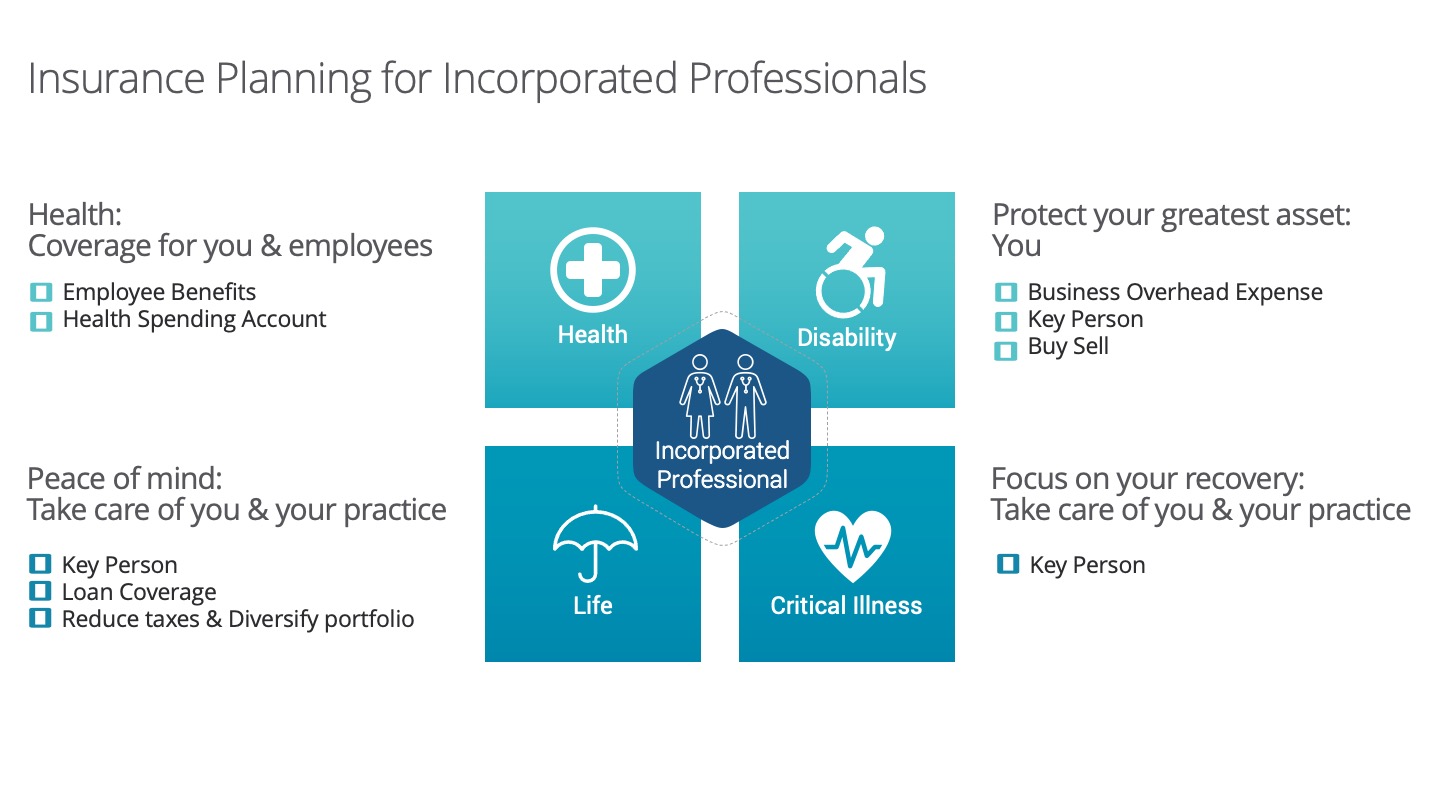
Insurance Planning for Incorporated Professionals

For incorporated professionals, making sure your practice is financially protected can be overwhelming. Incorporated professionals face a unique set of challenges when it comes to managing risk. Insurance can play an important role when it comes to reducing the financial impact on your practice in the case of uncontrollable events such as disability, or critical illness. This infographic and article address the importance of corporate insurance.

The 4 areas of insurance a incorporated professional should take care of are: 

  • Health 

  • Disability 

  • Critical Illness 

  • Life

Health: We are fortunate in Canada, where the healthcare system pays for basic healthcare services for Canadian citizens and permanent residents. However, not everything healthcare related is covered, in reality, 30% of our health costs* are paid for out of pocket or through private insurance such as prescription medication, dental, prescription glasses, physiotherapy, etc.

For incorporated professionals, offering employee health benefits make smart business sense because health benefits can form part of a compensation package and can help retain key employees and attract new talent.

For incorporated professionals that are looking to provide alternative health plans in a cost effective manner, you may want to consider a health spending account.

Disability: Most people spend money on protecting their home and car, but many overlook protecting their greatest asset: their ability to earn income. Unfortunately one in three people on average will be disabled for 90 days or more at least once before the age of 65.

Consider the financial impact this would have on your practice if you or a key employee were to suffer from an injury or illness. Disability insurance can provide a monthly income to help keep your practice running.

Business overhead expense insurance can provide monthly reimbursement of expenses during total disability such as rent for commercial space, utilities, employee salaries and benefits, equipment leasing costs, accounting fees, insurance premiums for property and liability, etc.

Key person disability insurance can be used to provide monthly funds for you or key employee while they’re disabled and protect the business from lost revenue while your business finds and trains an appropriate replacement.

Critical Illness: For a lot of us, the idea of experiencing a critical illness such as a heart attack, stroke or cancer can seem unlikely, but almost 3 in 4 (73%) working Canadians know someone who experience a serious illness. Sadly, this can have serious consequences on you, your family and business, with Critical Illness insurance, it provides a lump sum payment so you can focus on your recovery.

Key person critical illness insurance can be used to provide funds to the practice so it can supplement income during time away, cover debt repayment, salary for key employees or fixed overhead expenses.

Buy sell critical illness insurance can provide you with a lump sum payment if your business partner or shareholder were to suffer from a critical illness. These funds can be used to purchase the shares of the partner, fund a buy sell agreement and reassure creditors and suppliers.

Life: For an incorporated professional, not only do your employees depend on you for financial support but your loved ones do too. Life insurance is important because it can protect your practice and also be another form of investment for excess funds.

Key person life insurance can be used to provide a lump sum payment to the practice on death of the insured so it can keep the business going until you an appropriate replacement is found. It can also be used to retain loyal employees by supplying a retirement fund inside the insurance policy.

Loan coverage life insurance can help cover off any outstanding business loans and debts.

Reduce taxes & diversify your portfolio, often life insurance is viewed only as protection, however with permanent life insurance, there is an option to deposit excess funds not needed for operations to provide for tax-free growth (within government limits) to diversify your portfolio and reduce taxes on passive investments.  

Talk to us to make sure you and your practice are protected.