2025 Federal Budget Highlights

2025 Federal Budget Highlights

On November 4, 2025, the budget was delivered by the Honourable François-Philippe Champagne, Minister of Finance and National Revenue.

The 2025 Federal Budget focuses on stability, simplicity, and long-term growth. There are no broad tax increases or major new spending programs. Instead, the government is emphasizing restraint, modernization, and productivity.

For individuals and business owners, the goal is clear: help Canadians access benefits more easily, encourage investment in innovation and clean energy, and update trust and estate rules to maintain fairness across the system.

Economic Overview

Canada’s federal deficit is projected at $78.3 billion for 2025–26. The government aims to stabilize the debt-to-GDP ratio while maintaining funding for priorities such as housing, defence, and clean energy.

Spending will focus on programs that improve productivity, while efficiency reviews across departments are expected to reduce overlap and administrative costs. This marks a shift toward sustainable fiscal management and practical, targeted investments.

Personal and Family Tax Measures

Several measures are designed to make life more affordable, particularly for first-time home buyers, caregivers, and lower-income households.

Eliminating the GST for First-Time Home Buyers

First-time home buyers will not pay the 5 percent federal GST on new homes priced up to $1 million. For new homes between $1 million and $1.5 million, a partial GST reduction applies. This change provides meaningful savings and makes new construction more accessible for Canadians entering the housing market.

Home Accessibility Tax Credit

Starting in 2026, expenses can no longer be claimed under both the Home Accessibility Tax Credit and the Medical Expense Tax Credit. The rule prevents duplicate claims but continues to support renovations that make homes safer and more accessible for seniors or individuals with disabilities.

Top-Up Tax Credit

To balance the reduction in the lowest federal tax bracket—from 15 percent to 14.5 percent in 2025, and 14 percent in 2026—the government introduced a Top-Up Tax Credit to preserve the value of non-refundable credits such as tuition, medical, and charitable amounts. This temporary measure, available from 2025 through 2030, ensures Canadians receive the same credit value even as rates decrease.

Personal Support Workers (PSW) Tax Credit

A new refundable tax credit equal to 5 percent of eligible income, up to $1,100 per year, will be available for certified personal support workers beginning in 2026. The measure acknowledges the importance of care professionals and provides direct relief to those in long-term and community-care roles.

Automatic Federal Benefits

Starting in 2025, the Canada Revenue Agency will begin automatically filing simple tax returns for eligible Canadians who do not normally file. This will allow low-income earners and seniors to receive benefits such as the Canada Workers Benefit, GST/HST Credit, and Canada Carbon Rebate automatically. Those with more complex financial situations will continue to file regular returns.

Registered Plans, Trusts, and Estate Planning

The budget introduces several changes affecting trusts and registered plans—key tools in long-term financial and estate planning.

Bare Trust Reporting Rules

Implementation of new bare trust reporting requirements has been delayed. The rules will now apply to taxation years ending December 31, 2026, or later. This postponement gives individuals, trustees, and professionals more time to prepare for the new filing obligations.

The 21-Year Rule for Trusts

Trusts—particularly most personal or family trusts—are generally considered to have sold and repurchased their capital property every 21 years (a “deemed disposition”). This rule prevents indefinite deferral of capital-gains tax on assets that grow in value.

When property is moved on a tax-deferred basis from one trust to another, the receiving trust normally inherits the original 21-year anniversary date so that tax timing does not reset.

Some estate-planning arrangements have transferred trust property indirectly—for example, through a corporation or a beneficiary connected to a second trust—so that the transfer did not appear to be trust-to-trust. These arrangements effectively extended the period before capital gains would be recognized.

Budget 2025 broadens the anti-avoidance rule to include indirect transfers. Any transfer of property made on or after November 4, 2025, that effectively moves assets from one trust to another will retain the original 21-year schedule.

For families that use trusts in estate or business-succession planning, this change reinforces the importance of reviewing structure and timing. Trusts remain valuable for asset protection, legacy planning, and income distribution—this update simply ensures consistent application of the 21-year rule.

Qualified Investments for Registered Plans

Beginning January 1, 2027, all registered plans—RRSPs, TFSAs, FHSAs, RDSPs, and RESPs—will follow a single harmonized list of qualified investments. Small-business shares will no longer qualify for new contributions, though existing holdings will remain grandfathered. The update simplifies compliance and clarifies which assets can be held in registered accounts.

Business and Investment Incentives

For business owners, Budget 2025 provides opportunities to reinvest, innovate, and modernize operations, with emphasis on manufacturing, research, and clean technology.

Immediate Expensing for Manufacturing and Processing Buildings

Businesses can now claim a 100 percent deduction for eligible manufacturing and processing buildings acquired after Budget Day and available for use before 2030. This full write-off improves cash flow and encourages earlier expansion. The benefit will gradually phase out after 2033.

Scientific Research and Experimental Development (SR&ED)

The refundable SR&ED tax credit limit has increased from $3 million to $6 million per year, effective for taxation years beginning after December 16, 2024. This expansion strengthens support for small and medium-sized Canadian businesses investing in innovation and technology.

Tax Deferral Through Tiered Corporate Structures

To prevent deferrals of tax on investment income, new rules will suspend dividend refunds for affiliated corporations with mismatched fiscal year-ends. This ensures consistent taxation within corporate groups and aligns refund timing with income recognition.

Agricultural Co-operatives

The tax deferral for patronage dividends paid in shares has been extended to December 31, 2030, continuing to support agricultural co-operatives and their members.

Clean Technology and Clean Electricity Investment Credits

Clean-technology and clean-electricity incentives have been expanded to include additional critical minerals—such as antimony, gallium, germanium, indium, and scandium—used in advanced manufacturing and renewable energy production. The Canada Growth Fund can now invest in qualifying projects without reducing the amount of credit companies can claim, keeping the incentive structure attractive for green investment.

Canadian Entrepreneurs’ Incentive

The government has confirmed it will not proceed with the previously proposed Canadian Entrepreneurs’ Incentive. The existing Lifetime Capital Gains Exemption remains unchanged and continues to apply to the sale of qualified small-business shares.

Tax Simplification and Repealed Measures

To simplify administration and reduce complexity, two taxes are being repealed:

– Underused Housing Tax, beginning in 2025

– Luxury Tax on aircraft and vessels for purchases made after November 4, 2025

In addition, the Canada Carbon Rebate will issue its final household payment in April 2025, with no rebates available for returns filed after October 30, 2026. These changes are meant to streamline compliance and eliminate programs that were costly to administer.

Government Direction and Spending Priorities

Beyond taxation, the budget sets out the government’s broader policy priorities.

Downsizing Government: A comprehensive efficiency review is underway to eliminate duplication across departments and generate long-term savings.

Cuts to Immigration: To ease pressure on housing and infrastructure, temporary-resident levels will be reduced by about 20 percent over two years, while maintaining pathways for essential workers.

Defence Spending: Canada will invest an additional $7 billion over five years to strengthen NATO participation, Arctic defence, and cybersecurity. By 2030, defence spending is expected to reach 1.8 percent of GDP.

Oil and Gas Emission Cap: A phased-in cap starting in 2026 will allow companies to meet targets through carbon-capture and clean-tech investments rather than penalties.

Final Thoughts

For individuals, the most relevant updates include GST relief for first-time home buyers, improved benefit access, and continued tax relief for caregivers and support workers. For business owners, the focus remains on productivity—through immediate expensing, expanded SR&ED credits, and clean-tech investment incentives. For families using trusts or inter-generational structures, the clarified 21-year rule reinforces transparency in estate planning.

If you’d like to review what these changes mean for you or your business, please get in touch. We can look at your goals and make sure you’re well prepared for the year ahead.


Why a Critical Illness Insurance Top-Up Could Make a Big Difference

Most of us don’t expect to face a serious illness in our lifetime. But the truth is, health challenges such as cancer, heart disease, or stroke are more common than many people realize. In fact, about half of Canadians will develop cancer at some point in their lives. The question is—would your family or business be financially ready if something unexpected happened?

Critical illness insurance is designed to provide a lump-sum payment if you’re diagnosed with a covered illness. Many employees have some level of coverage through work, and some business owners purchase policies personally. But here’s the challenge: the amount of coverage included in a standard policy often isn’t enough to fully protect your income, household, or business. That’s where a “top-up” comes in.

Adding extra coverage can help close the gap, offering peace of mind and flexibility at a time when you’d want to focus fully on recovery.

Understanding the gap in coverage

Group insurance provided through an employer is a valuable benefit, but it usually comes with limits. For example, coverage amounts may be capped at a set level, such as $25,000 or $50,000. While helpful, this amount might not go far if you’re facing months away from work or costly medical treatments not fully covered by government health care.

For families, this shortfall can mean dipping into savings or going into debt just to keep up with everyday bills. For business owners, it could mean not having enough cash flow to keep operations running smoothly while stepping away to focus on health. A top-up ensures your coverage reflects your actual financial responsibilities, not just a general amount offered in a group plan.

Why families consider a top-up

If you’re raising children or supporting loved ones, an unexpected illness can bring financial stress on top of emotional strain. Mortgage payments, daycare costs, grocery bills, and education savings don’t pause when life takes a turn. A top-up can provide additional funds to help cover household expenses or even allow a spouse to take time off work to provide care.

Think of it as a financial cushion that allows your family to focus on what matters most—supporting your recovery—without the added worry of how to make ends meet.

Why employees might need more than their work plan

Relying only on your workplace benefits can leave you underinsured. Employer coverage usually ends if you change jobs, retire, or if your company makes changes to its benefits package. That means you could lose coverage at a time when it might be harder to qualify for new insurance.

By topping up your coverage personally, you’re not only increasing your protection—you’re also making sure you have something portable that stays with you, no matter where your career takes you. This stability can be especially valuable for professionals in industries where job changes are common.

Why business owners look at top-ups differently

For business owners, the stakes are even higher. A serious illness doesn’t just affect you personally—it can affect your entire company. From paying employees and suppliers to covering rent and utilities, your business may still need to run while you’re focused on treatment and recovery.

A top-up can provide a financial buffer to keep things running smoothly. It may also give you flexibility to hire temporary help, reduce workload, or take the time you need without rushing back before you’re ready. This not only protects your own livelihood but also helps safeguard your employees and clients who depend on you.

The benefits of a top-up

When deciding whether to add more coverage, here are some of the benefits families, employees, and business owners often value:

  • Peace of mind: Knowing you’re covered beyond the basics can relieve stress.
  • Financial flexibility: The lump-sum payment can be used for anything—from medical costs to everyday expenses.
  • Control: Unlike some insurance benefits, you choose how the funds are used.
  • Portability: A personal top-up stays with you, even if your job changes.
  • Business continuity: For entrepreneurs, extra coverage can help keep the business stable while you recover.

At its core, a critical illness insurance top-up is about creating a stronger safety net. It’s about having the right level of protection for your specific needs, rather than relying on a “one-size-fits-all” amount that may fall short.

Life is unpredictable, but preparing for the unexpected can make a big difference. By topping up your coverage, you’re helping ensure that if illness strikes, you and your loved ones can focus on what really matters—healing and moving forward.

If you’re unsure how much coverage is right for you, it may help to review your current benefits, your family’s expenses, and any business obligations you’re responsible for.

This is for informational purposes only and does not constitute financial, legal, or tax advice. Always consult a qualified professional regarding your specific situation. We are not responsible for any actions taken based on this content.

2024 Year-End Tax Tips and Strategies for Business Owners

brandableContent
brandableContent

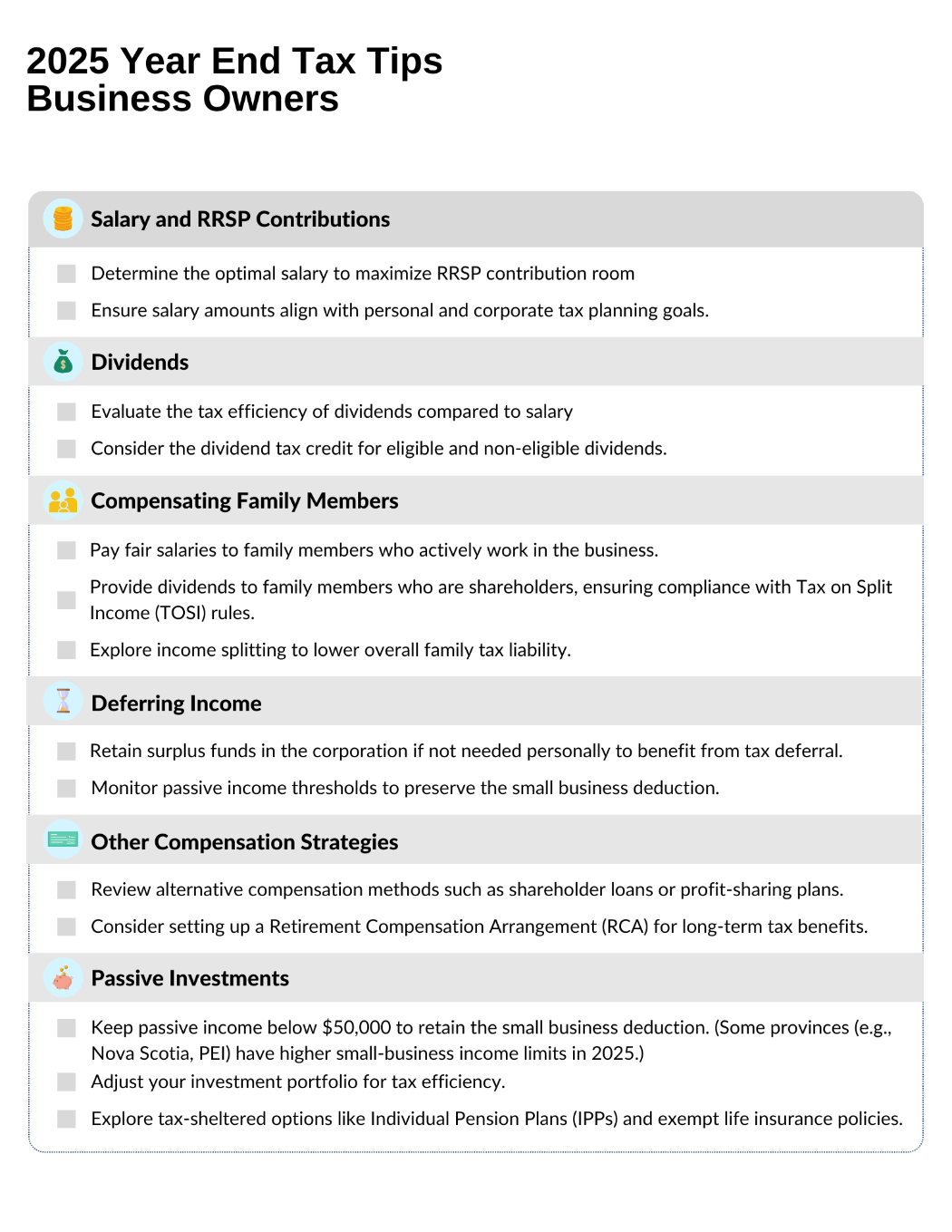
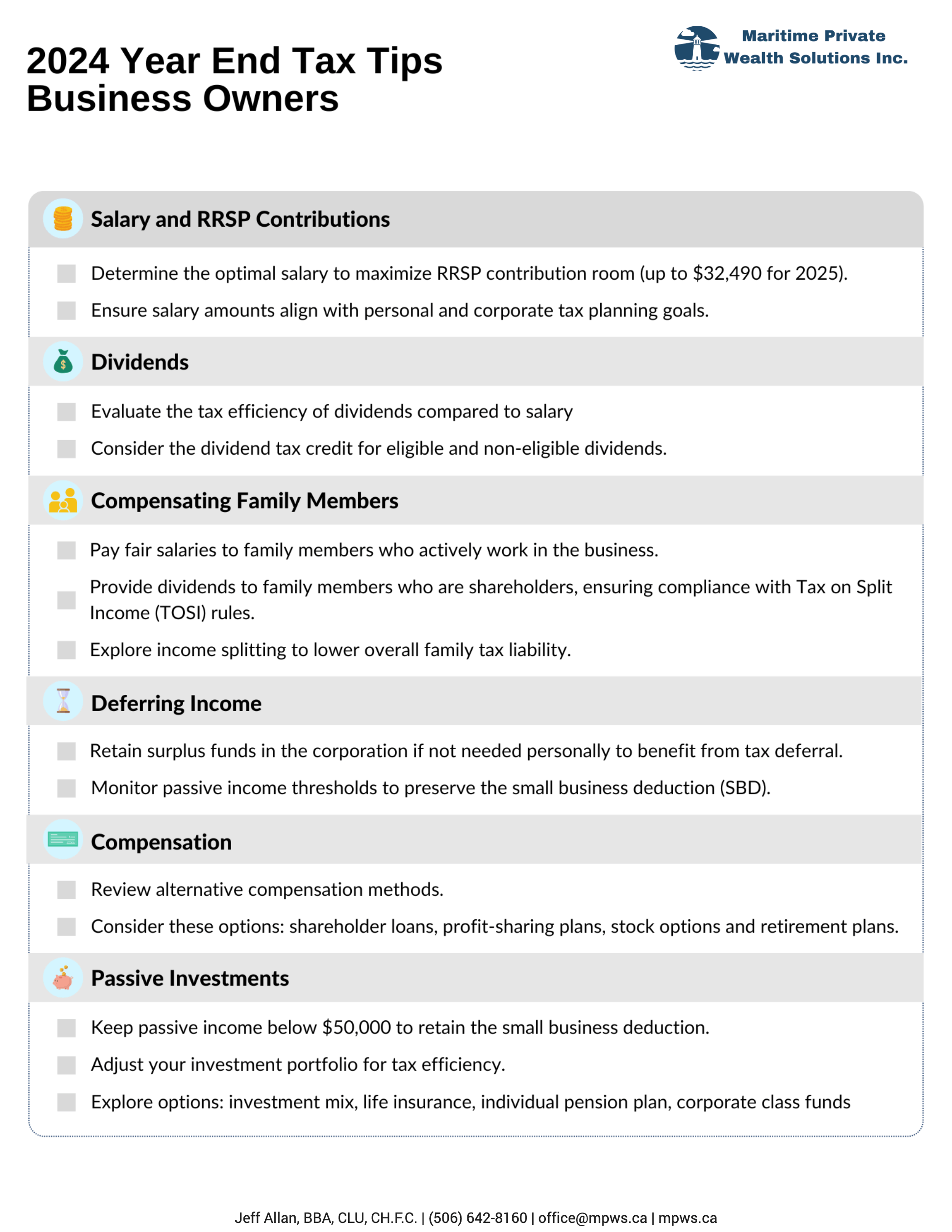
As a business owner, managing your finances well can make a big difference for your business’s future. Whether it’s choosing how to compensate yourself or making the most of opportunities like the small business deduction and lifetime capital gains exemption, thoughtful planning can help you save on taxes. This guide offers practical tips to help you make informed decisions.

Salary and RRSP Contributions

Taking a salary from your corporation can help reduce the company’s taxable income while creating RRSP contribution room for you. In 2024, a salary of up to $180,500 allows you to maximize your RRSP contribution room for 2025, which is $32,490.

Dividends

Dividends offer another way to take income from your business. They’re paid from the corporation’s after-tax income, but thanks to the dividend tax credit, they’re often taxed at a lower rate than salary.

Compensating Family Members

If family members are involved in your business, paying them can be a practical and tax-efficient option:

  • Salaries to Family Members: Paying a fair salary to family members who work for your business not only compensates them but also gives them access to RRSP contributions and CPP. You must be able to prove the family members have provided services in line with the amount of compensation you give them.

  • Dividends to Family Members: If family members are shareholders, dividends can provide them with tax-efficient income. The tax-free amount varies by province or territory, so it’s worth checking the rules where you live.

  • Income Splitting: Distributing income among family members can help reduce overall taxes. However, be mindful of the Tax on Split Income (TOSI) rules to avoid penalties. A tax professional can guide you through this process.

Deferring Income

If you don’t need the full amount for personal use, leaving surplus funds in the corporation could be a smart move. This keeps the money invested within the business, benefiting from lower corporate tax rates. Over time, this approach may allow the funds to generate more income compared to personal investing, depending on your goals and investment strategy. However, be mindful of passive investment income limits, as exceeding $50,000 in passive income could reduce or eliminate your corporation’s access to the small business deduction. Monitoring this threshold is essential to maintaining the tax advantages available to your business.

Compensation

It’s always a good idea to review how you handle compensation beyond base salary.

Consider these options:

  • Shareholder Loans: Borrow funds from your corporation with deductible interest but ensure repayment to avoid personal tax.

  • Profit-Sharing Plans: These can be a tax-efficient alternative to bonuses for distributing profits.

  • Stock Options: Only the employee or employer—not both—can claim a deduction when options are cashed out.

  • Retirement Plans: Explore setting up a Retirement Compensation Arrangement (RCA) to save for retirement tax-efficiently.

Passive Investments

Canadian-controlled private corporations (CCPCs) benefit from a reduced corporate tax rate on the first $500,000 of active business income, thanks to the small business deduction (SBD). The SBD can lower the tax rate by 12% to 21%, depending on your province or territory.

However, passive investment income over $50,000 in the previous year reduces the SBD by $5 for every additional dollar, potentially eliminating it altogether. To maintain access to the SBD, it’s important to keep passive investment income below this threshold.

Here are some strategies to help preserve your SBD:

  • Defer Portfolio Sales: Delay selling investments that generate capital gains if possible.

  • Optimize Your Investment Mix: Focus on tax-efficient investments like equities over fixed income.

  • Exempt Life Insurance Policies: Income earned within these policies isn’t included in your passive investment total.

  • Individual Pension Plan (IPP): This defined benefit plan is exempt from passive income rules and offers tax-advantaged retirement savings.

  • Consider Corporate Class Mutual Funds: These funds offer tax-efficient growth by deferring taxable distributions. While recent tax changes have limited their benefits, they remain a viable option for minimizing taxable passive income.

Carefully managing passive investments can help your business maintain access to the SBD and maximize its tax advantages for continued growth.

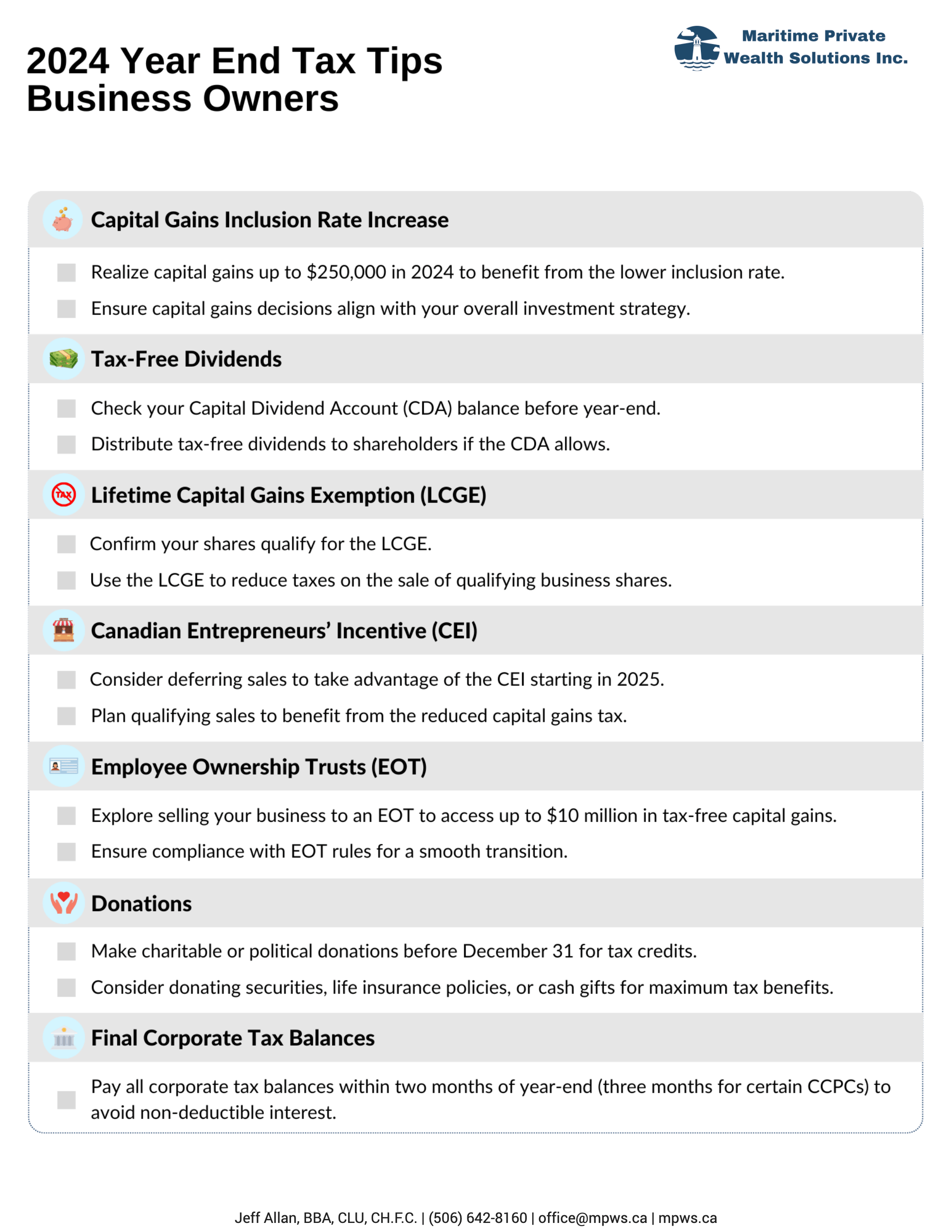
Capital Gains Inclusion Rate Increase

With recent changes to the capital gains inclusion rate, business owners personally holding investments with unrealized gains may want to consider realizing up to $250,000 in capital gains in 2024. This approach allows you to benefit from the lower tax rate on gains within this threshold, provided it aligns with your overall financial strategy.

Tax-Free Dividends

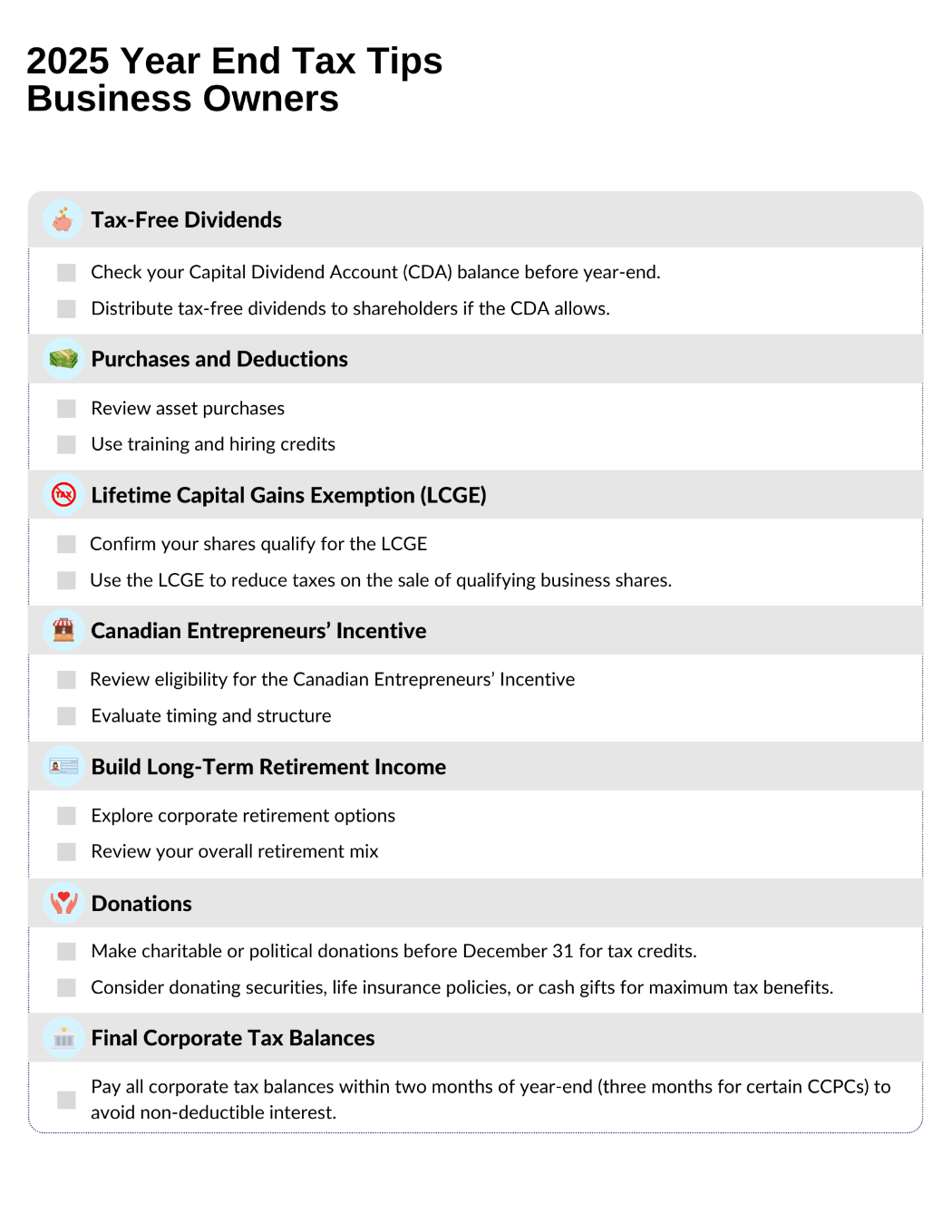
If your corporation has investments with losses that haven’t been sold yet, it’s a good idea to check the balance of its Capital Dividend Account (CDA) before selling. The CDA keeps track of the non-taxable portion of capital gains and some other amounts. You can pay tax-free dividends to shareholders using this account if you don’t go over the balance. However, if you sell investments at a loss, the CDA balance will go down, which might reduce or even remove your ability to pay these tax-free dividends. To avoid this, think about paying out any available tax-free dividends before selling investments at a loss.

Business Transition

If you’re planning to transition your business and believe its value has decreased, now might be a good time to explore options like an estate freeze or refreeze as part of your strategy.

Lifetime Capital Gains Exemption (LCGE)

The 2024 Federal Budget increased the LCGE from $1,016,836 to $1.25 million as of June 25, 2024. This allows you to benefit from tax savings on up to $1.25 million in capital gains over your lifetime when selling qualifying small business shares, farm properties, or fishing properties. Ensuring your corporate shares qualify for this exemption can help reduce the tax burden when selling or transferring your business.

Canadian Entrepreneurs’ Incentive (CEI)

The 2024 Federal Budget also introduced the Canadian Entrepreneurs’ Incentive (CEI) to lower taxes on selling qualifying shares. Starting June 25, 2024, the CEI reduces the taxable portion of capital gains to one-third for gains over $250,000 on qualifying sales.

In 2025, the CEI will go even further, lowering the taxable portion of capital gains to half the usual amount for up to $2 million in lifetime gains. This $2 million limit will start at $400,000 in 2025 and increase by $400,000 each year until it reaches $2 million in 2029.

To use the CEI, the shares must meet certain rules. However, it does not apply to shares of professional corporations or businesses focused on financial services, insurance, real estate, food and accommodation, arts, recreation, entertainment, consulting, or personal care services.

Together, the LCGE and CEI offer tax savings for business owners when selling or passing on their businesses.

Employee Ownership Trusts (EOT)

An EOT is a way for employees to own a business. A trust holds shares of the business on behalf of the employees, so they don’t have to pay directly to buy shares themselves.

Starting in 2024, EOTs are allowed in Canada. If a business is sold to an EOT in 2024, 2025, or 2026, the first $10 million in capital gains from the sale is tax-free, if certain conditions are met. This $10 million limit applies to the entire business, not to each individual shareholder. If multiple people sell shares to an EOT as part of the sale, they can each claim part of the exemption, but the total claimed by everyone combined can’t be more than $10 million. All sellers must agree on how to split the exemption.

Depreciable Assets

Purchasing depreciable assets can be a smart tax planning move, as they allow you to claim Capital Cost Allowance (CCA) to reduce taxable income.

To maximize the benefits:

  • Take advantage of the Accelerated Investment Incentive, which offers an enhanced first-year CCA for eligible assets.

  • Postpone selling depreciable assets if it could trigger recaptured depreciation in your 2024 tax year.

Timing your asset purchases and sales can help optimize your tax savings.

Donations

Making donations, whether charitable or political, can provide valuable tax benefits. To maximize these advantages, consider options like:

  • Donating securities

  • Giving a direct cash gift to a registered charity

  • Using a donor-advised fund for ongoing charitable contributions

  • Setting up a private foundation

  • Donating a life insurance policy by naming a charity as the beneficiary or transferring ownership.

Each option offers unique tax advantages depending on your situation.

Final Corporate Tax Balances

Pay your corporate taxes within two months of year-end (or three months for some CCPCs) to avoid interest charges that can’t be deducted.

Contact Us

For guidance on implementing these strategies, connect with your trusted tax professional. If you’d like to discuss how these tips align with your overall plan, let’s schedule a meeting.

Sources:

CPA Canada, “2024 Federal Budget Highlights,” https://www.cpacanada.ca/-/media/site/operational/sc-strategic-communications/docs/02085-sc_2024-federal-budget-highlights_en_final.pdf?rev=6d565a6a66ef4e20b1e01dc784464c93, 2024.


Government of Canada, “Capital Gains Inclusion Rate,” https://www.canada.ca/en/department-finance/news/2024/06/capital-gains-inclusion-rate.html, 2024.


Advisor.ca, “Lifetime Capital Gains Exemption to Top $1M in 2024,” https://www.advisor.ca/tax/tax-news/lifetime-capital-gains-exemption-to-top-1m-in-2024/, 2024.


PwC Canada, “Year-End Tax Planner,” https://www.pwc.com/ca/en/services/tax/publications/guides-and-books/year-end-tax-planner.html, 2024.


CIBC, “2024 Year-End Tax Tips,” https://www.cibc.com/content/dam/personal_banking/advice_centre/tax-savings/year-end-tax-tips-en.pdf, 2024.


Government of Canada, “Federal Budget 2024,” https://budget.canada.ca/2024/report-rapport/tm-mf-en.html, 2024.

How to Choose and Customize a Group Benefits Plan for Small Businesses

Building a Bright and Sustainable Future Together

As a small business owner, you recognize the significance of looking after your team and fostering a nurturing work environment. One method to demonstrate this is by providing a robust group benefits plan. This not only reflects your dedication to your team’s well-being but also is instrumental in drawing and retaining the best talent. Dive into the realm of group benefits and discover how to select and tailor the ideal plan for your small enterprise.

Understanding the Basics of Group Benefits

Group benefits plans are crafted to offer a variety of health, financial, and wellness advantages to your team members. These packages can encompass health and dental insurance, life and disability insurance, retirement savings alternatives, and more. The main benefit of a group benefits plan is its ability to distribute the risk among your team, making coverage more cost-effective and reachable for all.

Step 1: Assess Your Business Needs

Before diving into a group benefits plan, it’s vital to evaluate the requirements of your business and your team. Ponder over these questions:

  1. What’s the profile of your workforce? Think about age, family composition, and health statuses.
  2. Which benefits are most cherished by your employees? Is it health insurance, dental care, or retirement savings?
  3. How much can you allocate for group benefits? Keep in mind, offering benefits is a commitment to your team’s welfare.

Step 2: Collaborate with a Benefits Specialist

Teaming up with a benefits specialist is akin to having a navigator on your quest to devise the perfect plan. They will assist you in traversing the intricate landscape of insurance choices, rules, and compliance mandates. They’ll engage closely with you to grasp the distinct needs of your business and craft a plan that matches your budget and principles.

Step 3: Customize Your Plan

Adaptability is paramount when shaping a benefits plan that appeals to your team. Here are some avenues for personalization:

  1. Benefit Choices: Opt for a blend of health, dental, vision, life, and disability insurance based on what your team values.
  2. Wellness Initiatives: Mull over introducing wellness programs such as fitness center memberships, mental health resources, and stress alleviation workshops.
  3. Retirement Schemes: Offer retirement savings avenues like a Group RRSP or a staff pension scheme.

Step 4: Educate Your Employees

The efficacy of a group benefits plan hinges on transparent communication and enlightenment. Ensure your team comprehends the worth of the benefits provided and the methods to utilize them optimally. Arrange seminars, online sessions, or informational meetups to aid them in making knowledgeable choices about their coverage.

Step 5: Regularly Review and Adjust

The dynamics of your business and the needs of your team will transform over time. Hence, it’s crucial to revisit your group benefits plan annually and make requisite modifications. This guarantees that your plan stays in sync with your objectives and consistently delivers value to your team.

Building a Sustainable Future Together

As you embark on the path of picking and personalizing a group benefits plan for your small enterprise, bear in mind that your collaboration with your team is central to the process. By placing their welfare at the forefront and presenting a comprehensive benefits package, you’re not merely paving a brighter path for your team but also cultivating a sustainable work setting that promotes allegiance, efficiency, and expansion.

What is disability insurance?

If you cannot work because you are seriously injured or ill, disability insurance will provide you with a monthly, tax-free income to help replace your lost wages.  An injury does not have to be as blatant as a broken leg or arm – suffering from chronic pain or dealing with mental health issues can also qualify you for a disability insurance payout.  

Why do I need disability insurance?

Unfortunately, people become disabled – whether temporarily or permanently – quite often. In 2017, over 20 percent of Canadians had one or more disabilities. 

If you’re disabled, you may lose one of your most valuable assets – your ability to work and bring in a paycheck. Disability insurance can help replace that paycheck for as long as you need it to. Being able to rely on a disability insurance payout means you won’t have to dip into your savings if anything happens to you.

Disability insurance is especially important if you are self-employed, particularly if you are the family’s sole income earner.

What if I already have disability insurance through work?

If you have disability insurance through work, that’s great – but it may not replace 100 percent of your paycheck, especially if you’re off work for a long time. If you purchase private disability insurance, you can:

  • Choose how much coverage you want.
  • Adjust your coverage as needed.
  • Not have to worry if you leave your employer – you won’t lose your disability insurance coverage.

Having private disability insurance will give you peace of mind that you either have additional coverage if you are employed and at least some disability coverage if you lose your job.

How does disability insurance work?

We’d be happy to answer any questions you have about disability insurance. There are five main steps to disability insurance:

  1. Determine the amount of coverage you want. The higher your salary, the more coverage you should get.
  2. Pay your monthly premiums. Factors like your health, your age, and the amount of coverage you have will all impact the cost of your premiums.
  3. File a claim if you become disabled – we can help you with this.
  4. Receive your monthly payments once your waiting period has passed – a longer waiting period can lower your premiums, but it does mean you’ll go longer without any income.
  5. When you are healthy enough to return to work, or your coverage period runs out, you will stop receiving disability insurance payments.

We’re Here To Help

If you’d like to know more about disability insurance – from how much it would cost you to what you can file a claim for – we’re here to help! Give us a call today.

Network of Professionals

Our Network of Professionals

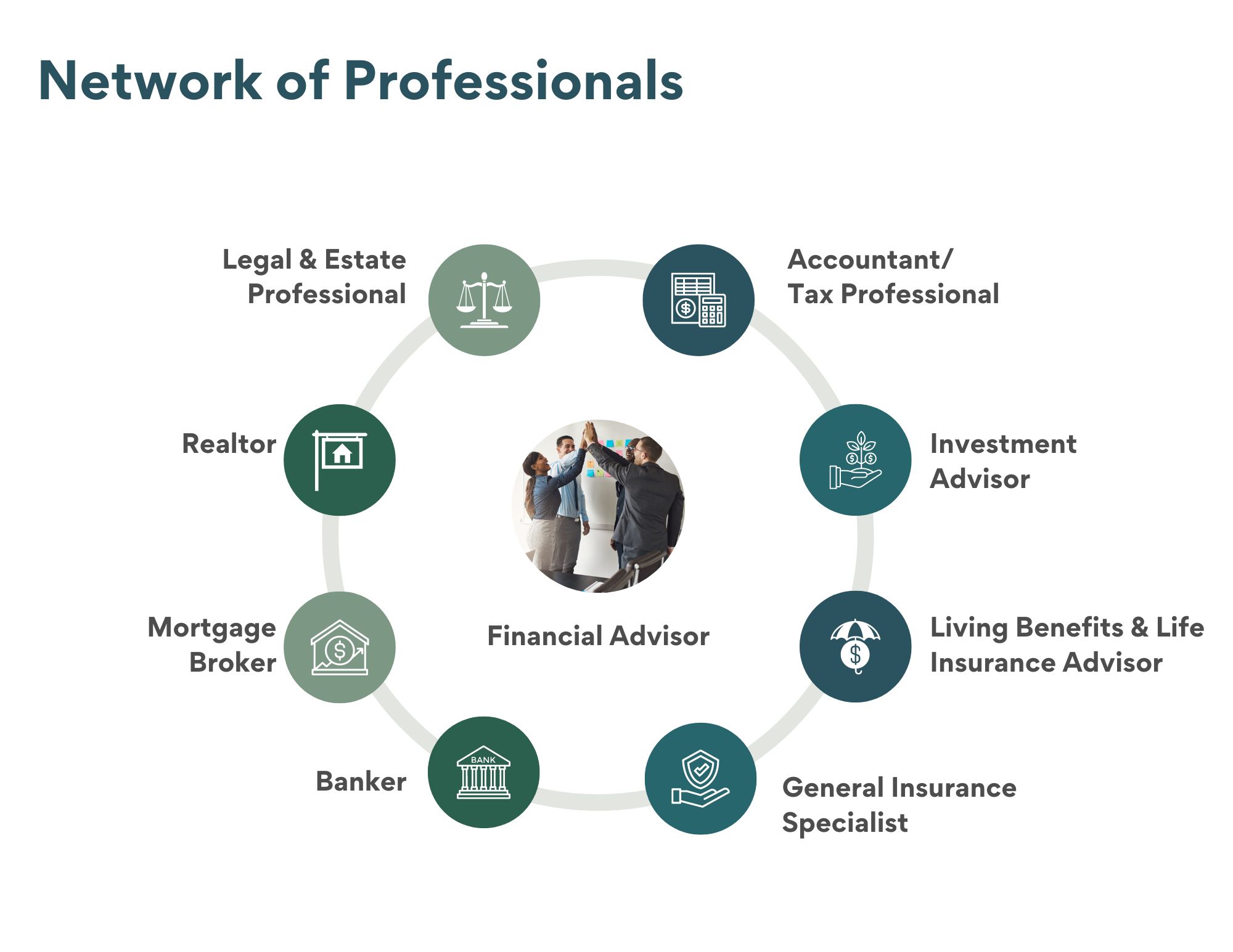
As a financial advisor, my primary goal is to help you achieve financial clarity. I do this by accessing a network of dedicated professionals, each bringing their unique expertise to the table. Together, we provide personalized advice and services that help you make informed decisions and secure your future.

Financial Advisor

Think of me as your financial coordinator. I help you figure out your goals, create plans to achieve them, and keep everything on track. Whether it’s planning for retirement, managing investments, or saving for a major purchase, I have access to a network of professionals who ensure every aspect of your financial life works together smoothly.

Accountant/Tax Professional

Having an accountant or tax professional in your financial network is essential for keeping your financial records in order. They handle tasks like bookkeeping, preparing financial statements, and assisting with tax planning. Their role is particularly important during tax season. They help you file your taxes accurately and on time, taking the stress out of the process. By optimizing your tax strategies and ensuring everything is reported correctly, they help you save money. Their skills are invaluable for both your immediate needs and long-term financial planning.

Investment Advisor

Investment advisors focus on building and managing investment portfolios tailored to your short-term, medium-term, and long-term goals. They thoroughly research the market, evaluate investment opportunities, and offer valuable insights to help you create a well-rounded portfolio. Whether you’re saving up for a major purchase, planning for retirement, or aiming for other financial milestones, they assist in choosing the right investment vehicles, such as RRSPs, TFSAs, RRIFs, and non-registered accounts, to support your financial stability and future needs.

Life Insurance and Living Benefits Advisor

Life insurance and living benefits advisors are here to help you protect your greatest asset: yourself. Their job is to make sure you and your family are financially secure if unexpected events occur. These advisors walk you through different insurance options, including disability insurance, critical illness insurance, and life insurance, to find the coverage that fits your needs best. By understanding your unique situation and recommending the right policies, they provide you with peace of mind, knowing that you have a safety net in place for life’s uncertainties.

General Insurance Specialist

General insurance specialists cover a wide range of insurance needs, including auto, property, travel, and liability insurance. They assess your risks and recommend policies that provide the protection you need. Their advice helps you understand your options, compare quotes, and select the best policies to safeguard your assets, ensuring you are well-protected in various aspects of your life.

Banker

Bankers are there to help you navigate a wide range of financial services, especially when it comes to getting loans and credit products. They offer advice on securing personal loans, understanding credit options, and managing debt effectively. Whether you’re looking to finance a major purchase, consolidate debt, or build your credit, bankers provide the support and guidance you need to make informed financial decisions.

Mortgage Broker

Mortgage brokers assist you in securing financing for property purchases by accessing multiple lenders on your behalf. They assess your financial situation, compare mortgage products from various sources, and recommend the best options for you. With their ability to shop around and understand different interest rates, loan terms, and application processes, they ensure you get the best possible mortgage deal, making homeownership more accessible and affordable.

Realtor

Realtors are your go-to professionals for buying or selling property. They provide market insights, negotiate deals, and manage the legal aspects of real estate transactions. With their knowledge of local market trends and property values, realtors help you make informed decisions whether you’re purchasing a home, investing in real estate, or selling property.

Legal & Estate Professional

Legal and estate professionals play a vital role in your financial planning by handling the legal side of things, such as estate planning, wills, trusts, and probate. They make sure your assets are distributed according to your wishes and that all the necessary legal documents are properly set up. Their guidance helps you reduce estate taxes and smoothly navigate the legal processes, ensuring your wealth is transferred to future generations just as you intended.

Having a network of financial professionals is essential for achieving financial well-being. Each member brings their own expertise to address different aspects of your finances, from investments and insurance to legal and real estate matters. As your financial advisor, I act as the coordinator, ensuring that all these professionals work together seamlessly. By leveraging their combined knowledge and skills, you can gain financial clarity and know that every aspect of your financial life is taken care of.

Ready to take control of your financial future? Contact us today.

Stay Ahead in 2024: A Comprehensive Checklist for Federal Tax Updates

With the upcoming 2024 Canadian tax rule changes, it’s important to review your financial strategies. We’ve identified the key changes that we expect to influence financial decisions for investors, business owners, incorporated professionals, retirees, and individuals with high income or net worth.


Capital Gains Inclusion Rate

Starting on June 25, 2024, the tax on capital gains is changing. Until now, you would only have to include half of your capital gains in your income for tax purposes. But after that date, you’ll have to include two-thirds of any capital gains over $250,000 on your tax return. This is also the case for employee stock options. 

Consequently, for corporations and trusts, they will have to include two-thirds of all their capital gains, no matter the amount. This is a significant change. 


Lifetime Capital Gains Exemption (LCGE)

The budget proposes increasing the LCGE for qualified capital gains from $1,016,836 to $1.25 million, effective for sales made after June 24, 2024. This change increases tax benefits for individuals selling certain types of property, such as small business shares or farming and fishing assets.


Alternative Minimum Tax (AMT)
The 2023 budget included updates to the AMT, suggesting revising the charitable donation tax credit for AMT calculations, increasing the claimable amount from 50% to 80%.


Employee Ownership Trust (EOT)

The budget proposes a tax exemption on up to $10 million in capital gains for individuals selling their businesses to an EOT if certain criteria are met. 


Canadian Entrepreneurs’ Incentive

This new tax measure offers a reduced inclusion rate of 1/3 for up to $2 million in capital gains during an individual’s lifetime, with this limit being phased in over 10 years. However, it’s important to know that not all businesses qualify—this doesn’t apply to businesses in professional services, finance, real estate, hospitality, arts, entertainment, or personal care.

Below is a checklist to help you navigate the tax adjustments and ensure your financial plans are updated and aligned with the new rules.


Investors

  • Investments: Evaluate portfolios to identify where capital gains can be realized under the current lower inclusion rate.

  • Investment Property: Consider advancing the sale of such properties to benefit from the existing capital gains rate.

  • Estate Planning: Revise plans to address potential increases in capital gains taxes, ensuring estates are structured for tax efficiency.

  • Employee Stock Options: Adjust the timing of exercising stock options to align with the upcoming changes in inclusion rates.


Business Owners:

  • Corporate Investments: Assess the impact of increased inclusion rates on corporately held assets, exploring the timing of gains realization. Review trust-held investments. 

  • Lifetime Capital Gains Exemption: Maximize the benefits of the increased LCGE for qualifying business assets.

  • Employee Ownership Trust: Consider the advantages of transferring business ownership via an EOT.

  • Succession Planning: Update your succession plans to consider the potential impact of capital gains tax changes.

  • Entrepreneurs Incentive: Check if you are eligible to reduce capital gains taxes. 


Incorporated Professionals:

  • Investments: Assess both personal and corporate investments for the new inclusion rate. Determine the most tax-effective structure for holding and realizing gains from investments.

  • Succession Planning: Time the potential sale of your professional corporation to capitalize on the current LCGE.


Retirees:

  • Estate Planning: Update estate plans considering the impending increase in capital gains rates.

  • Life Insurance Coverage: Ensure life insurance is adequate to cover increased capital gains tax liabilities upon death.

  • Non-Registered Investments and Retirement Income: Review your strategy for non-registered investments to manage taxes on gains and adjust your retirement income plans to accommodate the upcoming changes in capital gains rates.


Individuals with High Income or Net Worth: 

  • Investments: Evaluate portfolios to identify where capital gains can be realized under the current lower inclusion rate. Review trust-held investments. 

  • Investment Property: Consider advancing the sale of such properties to benefit from the existing capital gains rate.

  • Estate Planning: Revise plans to address potential increases in capital gains taxes, ensuring estates are structured for tax efficiency.

  • Charitable Contributions: Align your charitable giving strategies with the new tax benefits and AMT considerations.

Please reach out to us to review your financial strategy together and ensure it aligns with the upcoming changes. 

2024 Federal Budget Highlights

On April 16, 2024, Canada’s Deputy Prime Minister and Finance Minister, Chrystia Freeland, presented the federal budget.

While there are no changes to federal personal or corporate tax rates, the budget introduces:

  • An increase in the portion of capital gains subject to tax, rising from 50% to 66.67%, starting June 25, 2024. However, individual gains up to $250,000 annually will retain the 50% rate.

  • The lifetime exemption limit for capital gains has been raised to $1.25 million. Additionally, a new one-third inclusion rate is set for up to $2 million in capital gains for entrepreneurs.

  • The budget confirms the alternative minimum tax changes planned for January 1, 2024 but lessens their impact on charitable contributions.

  • This year’s budget emphasizes making housing more affordable. It provides incentives for building rental properties specifically designed for long-term tenants.

  • Introduces new support measures to aid people buying their first homes.

  • Costs for specific patents and tech equipment and software can now be written off immediately.

  • Canada carbon rebate for small business.

Capital Gains Inclusion Rate

The budget suggests raising the inclusion rate on capital gains after June 24, 2024:

  • Corporations and trusts, from 50% to 66.67%.

  • Individuals, on capital gains over $250,000 annually, also from 50% to 66.67%.

For individuals, the $250,000 annual threshold that applies to net capital gains—the amount remaining after offsetting any capital losses. This includes gains acquired directly by an individual or indirectly through entities such as partnerships or trusts. Essentially, this threshold acts as a deductible, considering various factors to determine the net gains eligible for the increased capital gains tax rate.

Individuals in the highest income bracket, who earn above the top marginal tax rate threshold, will face a higher tax rate on capital gains exceeding $250,000 due to these changes. Furthermore, the budget modifies the tax deduction for employee stock options to align with the updated capital gains taxation rates yet maintains the initial 50% deduction for the first $250,000 in gains. Regarding previously incurred financial losses, the budget plans to adjust the value of these net capital losses from past years so that they are consistent with the current gains, upholding the uniformity with the new inclusion rate.

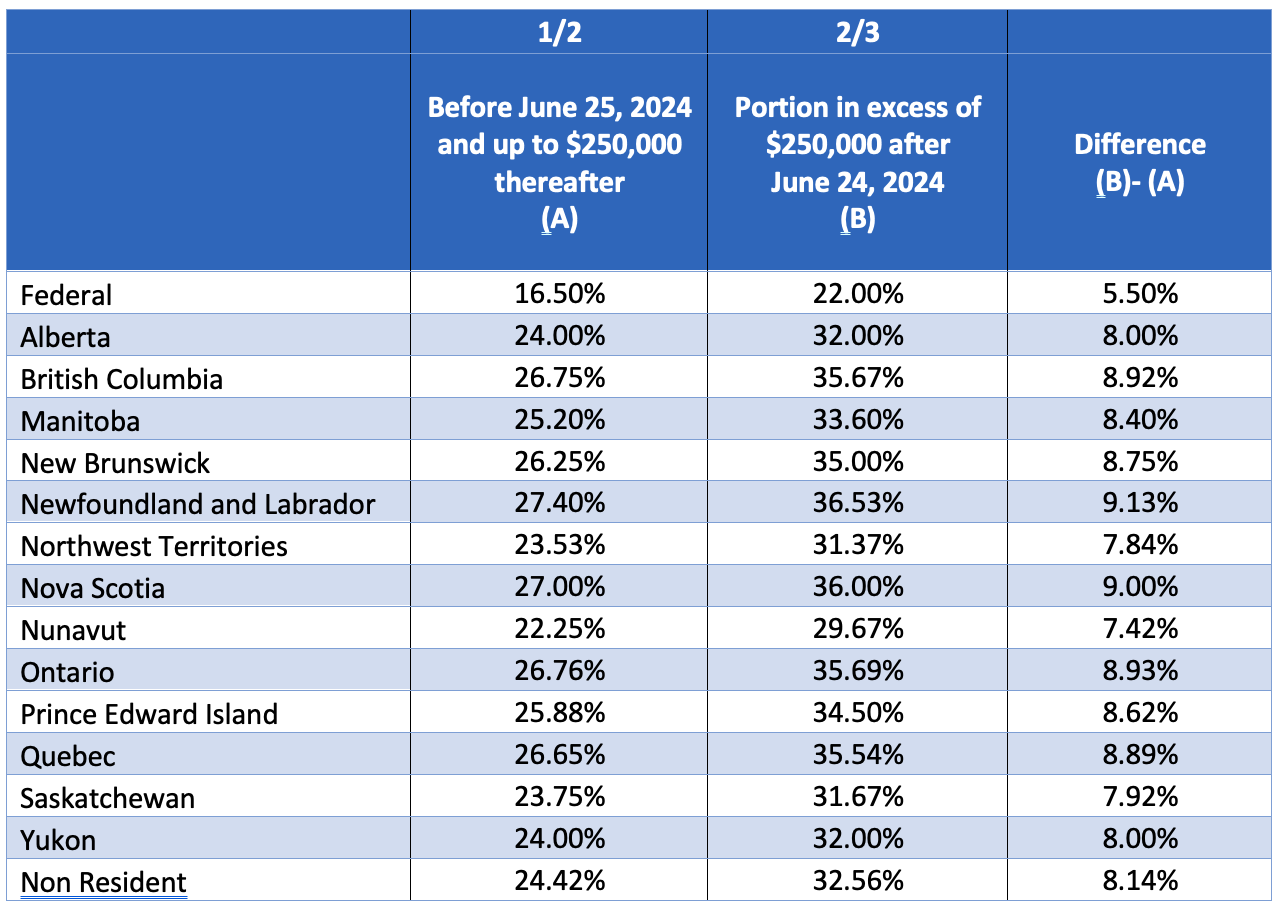
The budget outlines transitional rules for the upcoming tax year that straddles the implementation date of the new capital gains rates. If the tax year begins before June 25, 2024, but ends afterward, capital gains realized before June 25 will be taxed at the existing rate of 50%. However, gains accrued after June 24, 2024, will be subject to the increased rate of 66.67%. It’s important to note that the new $250,000 threshold for higher tax rates will only apply to gains made after June 24.

Consequently, for individuals earning capital gains beyond the $250,000 threshold and who fall into the highest income tax bracket, new rates will be effective as outlined in the table below. Specifically, this pertains to individuals with taxable incomes exceeding $355,845 in Alberta, $252,752 in British Columbia, $1,103,478 in Newfoundland and Labrador, $500,000 in the Yukon, and $246,752 in all other regions.

Further details and guidance on these new rules are expected to be provided in future announcements.

Lifetime Capital Gains Exemption

The budget proposes raising the Lifetime Capital Gains Exemption (LCGE) for qualified capital gains from $1,016,836 to $1.25 million, effective for sales made after June 24, 2024. Additionally, the exemption will once again be adjusted for inflation starting in 2026. This change aims to increase the tax benefits for individuals selling certain types of property, such as small business shares or farming and fishing assets.

Canadian Entrepreneurs’ Incentive

The Canadian Entrepreneurs’ Incentive is a new tax measure which provides a reduced inclusion rate on capital gains from the disposition of qualifying small business shares.

Qualifications for the incentive include:

  • Shares must be of a small business corporation directly owned by an individual.

  • For 24 months before selling, over half the corporation’s assets must be actively used in a Canadian business or be certain connected assets.

  • The seller needs to be a founding investor who held the shares for at least five years.

  • The seller must have been actively involved in the business continuously for five years.

  • The seller must have owned a significant voting share throughout the subscription period.

  • The incentive does not apply to shares linked to professional services, financial, real estate, hospitality, arts, entertainment, or personal care services sectors.

  • The shares must have been acquired at their fair market value.

  • The incentive allows for a reduced inclusion rate of 1/3 for up to $2 million in capital gains during an individual’s lifetime, with this limit being phased in over 10 years.

This measure will apply to dispositions after December 31, 2024.

Alternative Minimum Tax (AMT)

The 2023 budget included updates to the AMT, with proposed changes outlined in the summer of 2023. The budget suggests revising the charitable donation tax credit for AMT calculations, increasing the claimable amount from 50% to 80%.

Further proposed changes to the AMT include:

  • Permitting deductions for the Guaranteed Income Supplement, social assistance, and workers’ compensation benefits.

  • Exempting employee ownership trusts (EOTs) entirely from AMT.

  • Allowing certain tax credits, like federal political contributions, investment tax credits (ITCs), and labour-sponsored funds tax credit, to be carried forward if disallowed under the AMT.

These changes would take effect for tax years beginning after December 31, 2023. Additionally, the budget proposes technical amendments that would exempt specific trusts benefiting Indigenous groups from the AMT.

Employee Ownership Trust (EOT) Tax Exemption

The budget proposes a tax exemption on up to $10 million in capital gains for individuals selling their businesses to an EOT if certain criteria are met:

  • Sale of shares must be from a non-professional corporation.

  • The seller, or their spouse or common-law partner, must have been actively involved in the business for at least two years prior to the sale.

  • The business shares must have been solely owned by the seller or a related person or partnership for two years before the sale, and mainly used in active business.

  • At least 90% of the EOT’s beneficiaries must be Canadian residents after the sale.

  • If multiple sellers are involved, they must jointly decide how to divide the $10 million exemption

  • If the EOT doesn’t maintain its status or if the business assets used in active business drop below 50% at any point within 36 months after the sale, the tax exemption may be revoked.

  • For Alternative Minimum Tax purposes, the exempted gains will face a 30% inclusion rate.

  • The normal reassessment period for the exemption is extended by three years.

  • The measure now also covers the sale of shares to a worker cooperative corporation.

This exemption is valid for sales occurring from January 1, 2024, to December 31, 2026.

Home Buyers Plan (HBP)

The budget proposes enhancements to the HBP for 2024 and beyond, effective for withdrawals after April 16, 2024. These include:

  • Raising the RRSP withdrawal limit from $35,000 to $60,000 to support first-time homebuyers and purchases for those with disabilities.

  • Extending the grace period before repayment starts from two to five years for withdrawals made between January 1, 2022, and December 31, 2025, deferring the start of the repayment period and thereby providing new homeowners additional time before they need to commence repayments

Interest Deductions and Purpose-Built Rental Housing

The budget proposes a selective exemption from the Excessive Interest and Financing Expenses Limitation (EIFEL) rules for certain interest and financing expenses related to arm’s length financing. This exemption is for the construction or purchase of eligible purpose-built rental housing in Canada and applies to expenses incurred before January 1, 2036. To qualify, the housing must be a residential complex with either at least four private apartment units, each with its own kitchen, bathroom, and living areas, or 10 private rooms or suites. Additionally, at least 90% of the units must be designated for long-term rental. This exemption will be effective for tax years starting on or after October 1, 2023, in line with the broader EIFEL regulations.

Accelerated Capital Cost Allowance (CCA) – Purpose built rental housing

The budget introduces an accelerated CCA of 10% for new rental projects that start construction between April 16, 2024, and December 31, 2030, and are completed by December 31, 2035. This accelerated depreciation applies to projects that convert commercial properties into residential complexes or expand existing residential buildings that meet specific criteria under the EIFEL rules. However, it does not cover renovations to existing residential complexes.

Additionally, these investments will benefit from the Accelerated Investment Incentive, which allows for immediate depreciation deductions for properties put into use before 2028. Starting in 2028, the regular depreciation rules, including the half-year rule, will apply.

Accelerated Capital Cost Allowance (CCA)- Productivity-enhancing assets

The budget introduces immediate expensing for newly acquired properties that become operational between April 16, 2024, and December 31, 2026. This applies to specific categories such as:

  • Class 44- Patents and rights to patented information

  • Class 46- Data network infrastructure and related software

  • Class 50- General electronic data-processing equipment and software

Properties that are put into use between 2027 and 2028 will continue to benefit from the Accelerated Investment Incentive.

To qualify for this accelerated depreciation, the property must not have been previously owned by the taxpayer or someone closely connected to them, and it must not have been received as part of a tax-deferred deal. Also, if a tax year is shorter, the depreciation will be adjusted accordingly and will not carry over to the next year.

Canada Carbon Rebate for Small Businesses

The budget introduces a Canada Carbon Rebate for small businesses, offering a new refundable tax credit automatically. To be eligible, a Canadian-controlled private corporation must:

  • File a tax return for its 2023 tax year by July 15, 2024, for the fuel charge years from 2019-20 to 2023-24. For subsequent fuel charge years, it must file a tax return for the tax year that ends within that fuel charge year.

  • Employ 499 or fewer people across Canada during the year that corresponds with the fuel charge year.

The amount of the tax credit for each eligible business will depend on:

  • The province where the company had employees during the fuel charge year.

  • The number of employees in that province multiplied by a rate set by the Minister of Finance for that year.

  • The CRA will automatically calculate and issue the tax credit to qualifying businesses.

We can help!

Wondering how this year’s budget will impact your finances or your business? We can help – give us a call today!

Why A Buy-Sell Agreement Is Vital For Your Business

Why A Buy-Sell Agreement Is Vital For Your Business

The purpose of a buy-sell agreement is to establish a set of rules or actions (that are legally binding) for what must happen to a business if one or more of the business owners is no longer involved.

Why does my business need a buy‐sell agreement?

A buy-sell agreement is vital for your business as it protects the shareholders and the business itself if one of the partners exits the business for any reason.

A buy-sell agreement offers so many benefits for your business. It:

  • Can help maintain the continuity of your business.
  • Minimize disputes between remaining co-owners and the family of the departing owner.
  • Decrease stress and uncertainty for all business owners.
  • Protect business assets and liquidity by including a solid financial and tax plan.

What are the different types of buy-sell agreements?

These are the most common types of buy-sell agreements:

  • A cross-purchase agreement. In this agreement, each remaining shareholder agrees to buy a percentage of the shares owned by the departing shareholder. The purchase can be funded by life insurance in case of the death of one of the shareholders.
  • A promissory note agreement. Each shareholder has corporate-owned life insurance in this agreement, and the corporation is the beneficiary. If a shareholder dies, the surviving shareholder(s) use a promissory note to purchase the deceased’s shares from their estate. The shareholders then use a capital dividend provided by the life insurance to pay off the promissory note.
  • A share redemption arrangement. This is similar to the promissory note agreement set up, but no promissory note is involved, and the capital dividend account pays for the deceased shareholder’s shares.

What do I need to cover in my buy‐sell agreement?

Your buy-sell agreement must address the following:

  • Valuation of the company.
  • Ownership interests.
  • Buyout clauses.
  • Terms of payment.
  • What will happen in the event of any “triggering events.”. These events can include a disagreement between business owners, a business owner getting divorced or retiring, a business owner going bankrupt or becoming disabled, or a business partner dying.

What is the best way to fund my buy-sell agreement?

This needs to be addressed when putting the buy-sell agreement together and can be challenging in the case of some “triggers,” such as a business owner getting a divorce or a disagreement between business owners.

In the case of the death of a business owner or a business owner becoming disabled, the buy-sell agreement can be funded by insurance. Insurance provides both immediate capital and significant tax benefits.

We Can Help!

Buy-sell agreements can be complex and challenging, but they are vital to protect your business and your personal interests. We can explain the best way to set one up – reach out to us today to get started!

Protecting Key Talent using Group Benefits

Building a Sustainable Future Together

As specialists in group benefits, the primary goal is to cultivate a sustainable future by collaborating closely with clients. The belief is that an informed and engaged workforce is pivotal for the success of any organization. A key component of this vision is the protection of the organization’s essential talent. This article delves into how group benefits can be instrumental in safeguarding an organization’s most treasured resource: its people.

The Importance of Essential Talent

Essential talent encompasses those employees who bring critical skills, expertise, and knowledge that propel an organization’s growth and success. These individuals form the core of any organization, ensuring its prosperity in the competitive market. Retaining such invaluable members is crucial as their absence can significantly affect business operations, productivity, and overall morale.

Challenges in Retaining Essential Talent

In the ever-evolving job market, holding onto essential talent can be a daunting task. Numerous factors, including enticing offers from rivals, opportunities for personal growth, work-life equilibrium, and employee well-being, can influence retention. For employers, recognizing and addressing these challenges is vital to safeguard top performers and sustain a competitive advantage.

The Significance of Group Benefits

Group benefits serve as a potent strategy in attracting and retaining essential talent. By presenting comprehensive and tailored benefits packages, organizations showcase their dedication to the well-being, security, and future of their employees. Here are some pivotal aspects of group benefits that aid in retaining essential talent:

  1. Health and Wellness Coverage: Offering comprehensive health and wellness benefits, such as medical, dental, and vision plans, not only fosters a healthy workforce but also signifies an organization’s commitment to overall employee well-being. Employees who feel this support are more inclined to stay loyal.
  2. Income Protection: Many group benefits packages encompass disability insurance, offering financial security for employees facing injuries or illnesses that hinder their work. Such provisions alleviate financial concerns during tough times, fostering a sense of stability and encouraging talent to remain with the organization.
  3. Retirement Planning: A meticulously crafted retirement plan appeals to essential talent. It signifies an organization’s concern for their future and dedication to ensuring their financial comfort during retirement. Contributing to such plans also strengthens the bond between employers and employees.
  4. Support for Work-Life Balance: Benefits that champion work-life balance, like flexible work schedules, paid leaves, and family leaves, reflect an organization’s understanding of the significance of a balanced life. Employees who sense this flexibility are more likely to remain devoted.
  5. Career Advancement: Benefits can also encompass professional development and training opportunities. Investing in employee growth not only sharpens their skills but also underlines an organization’s commitment to their long-term achievements.

Educational Approach and Teamwork

The role of group benefits specialists is to offer educational support and foster collaboration with clients. Through open dialogues about an organization’s aspirations and needs, it’s possible to design group benefits packages that resonate with specific demands. The collective goal is to nurture and protect essential talent, ensuring a sustainable future.

Protecting essential talent through group benefits is more than a strategic move; it embodies a dedication to employee welfare. By investing in the well-being, security, and future of employees, organizations not only boost loyalty and retention but also lay the foundation for a robust and sustainable future. The journey ahead is one of partnership, aiming for a flourishing and vibrant workforce.